Tell us where you are
A three-minute placement quiz puts you on the right shelf. Total beginner, rusty intermediate, or somewhere in between.
This is the Palestinian Arabic spoken in kitchens and corner shops, the dialect your family actually uses. Ten minutes a day, audio first. Most people are holding a real conversation in six to eight weeks.


Ten phrases you’ll actually use on a visit to Palestine. Each comes in easy phonetic spelling and in Arabic, with audio so you hear how it really sounds. Free PDF, straight to your inbox. Sign up now and founding pricing stays locked in.
You’ll get the pack, then the odd update. Unsubscribe anytime.
How it works
A three-minute placement quiz puts you on the right shelf. Total beginner, rusty intermediate, or somewhere in between.
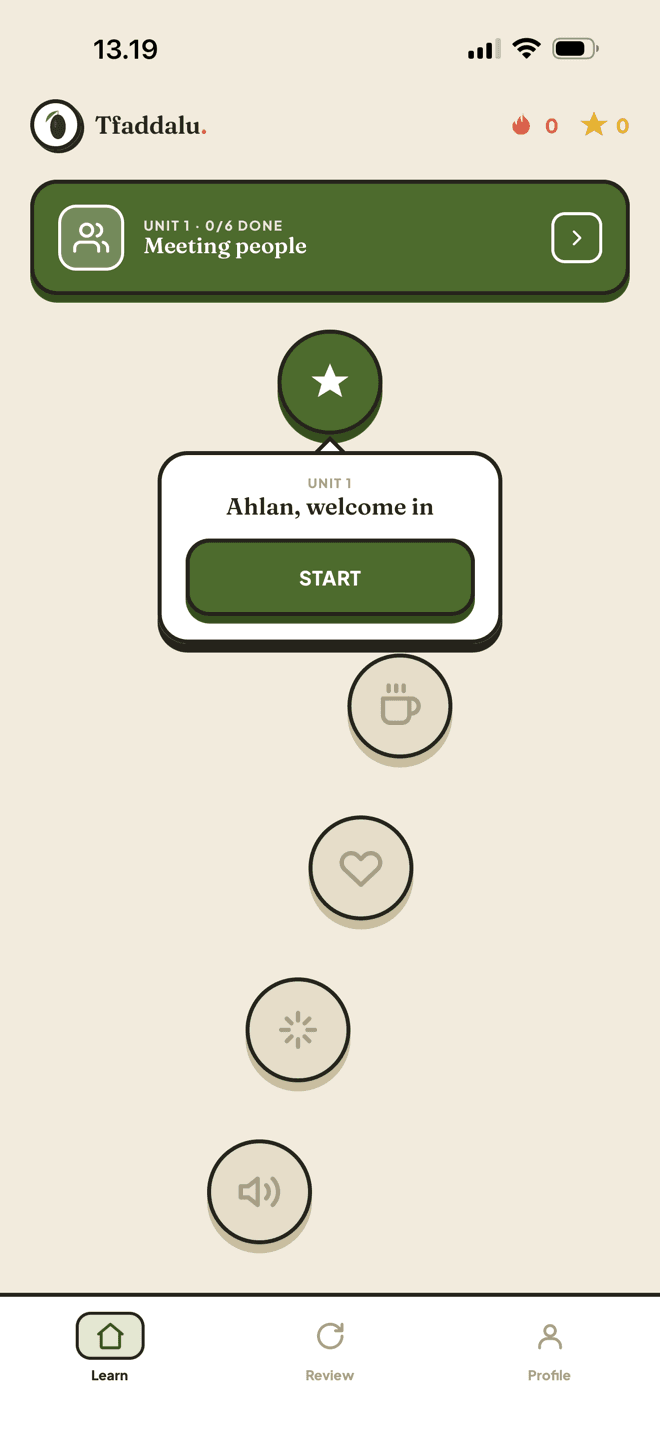
Bite-sized lessons. Audio first. Hands-free if you want.
Order coffee. Greet your neighbor. Catch a phrase in a song. Real situations from day one, not month six.
The method
We start from the language as it’s really spoken at home, not the version textbooks teach. You hear every word before you read it, and you pick it up in the order you’d actually need it.
Every word reaches your ear before it reaches your eye. Five-second clips, played back until they stick. That's the old Pimsleur idea, retuned for a Palestinian rhythm.
A phonetic system for the sounds the script keeps hidden. The 3 in 3ayn. The 7 in 7alaal. The q that quietly goes missing in Jerusalem. And when you want the Arabic letters themselves, ع and ح are waiting right beside it.
Every unit has an address: a fish market in Yafa, a café in Ramallah, the carpentry shop down your in-laws' alley. Learn the words and you've half-learned the place they belong to.
Built for five spare minutes and a pair of headphones. A lesson fits a phone and a bus seat. Nothing to install, no laptop, no homework to hand in. Press play, say back what you hear, and that's the lesson.
The tasting menu
Not “the cat sat on the mat.” Not “where is the library.” These are the ones you reach for first: greeting a neighbor, talking a vendor down on a watermelon, thanking the stranger who pointed you toward the bus in Akka.
#1
mar7aba
مرحبا
hello
#2
keef 7aalak?
كيف حالك؟
how are you?
#3
shukran
شكراً
thank you
#4
Sabaa7 il-kheer
صباح الخير
good morning
Want all ten? Grab the printable pack, with the Arabic script and audio on every phrase.
You’ll get the pack, then the odd update. Unsubscribe anytime.
Culture first
Words don’t stick in a vacuum. Every unit sits inside a real Palestinian dish, place, or custom, because that’s where the vocabulary belongs. Learning vegetables? You’re cooking maqloobe. Numbers? You’re haggling in a market. Family words? You’re three chairs deep at someone’s wedding.
كنافة نابلسية
knaafe nablusiyye
Knafeh, Nablus-style
مقلوبة
maqloobe
Upside-down rice
مسخّن
msakhan
Sumac chicken on bread
قهوة سادة
qahwe saade
Black cardamom coffee
Free guides
Still picking your tools? Start with the best app to learn Levantine Arabic, then come back for the phrases.
ABOUT
Almost nothing targets Palestinian. What the Levantine courses really give you, where their accent lands, and a five-minute test to run before you pay.
6 min read · 9 audio clips
ABOUT
No. Duolingo's one Arabic course is Modern Standard, taught script-first. What that means for spoken Levantine, and what your finished units still count for.
5 min read · 6 audio clips
ABOUT
Almost everyone tells you to start with Modern Standard Arabic. The case for the other order, and the goals where the standard really does come first.
6 min read · 6 audio clips
CULTURE
Close enough to talk all afternoon, different enough to place you in one sentence. The vowels, the q, and the everyday words that give each side away.
7 min read · 13 audio clips
ABOUT
You follow every word at your grandmother's table and answer in English. Understanding and speaking are two skills, and only one of them ever got practiced.
6 min read · 9 audio clips
ABOUT
Egyptian, Levantine, Gulf, Moroccan or Modern Standard. How to pick by who you'll actually be talking to, not by which dialect has the biggest number.
6 min read · 4 audio clips
The starter pack now, then a new guide every couple of weeks. No more than that.
You’ll get the pack, then the odd update. Unsubscribe anytime.
Honest answers
No dodges. If a question reaches us more than twice, it ends up on this list.
Yes, on both stores. Tfaddalu is live on the App Store and on Google Play, free to try. If you'd like the printable starter pack too, the email box above still sends it.
Eventually, yes. From your first lesson the Arabic script sits next to the transliteration, so you can lean on whichever you want. We don't formally drill the alphabet until Unit 4, but the letter shapes start sinking in from your very first knafeh order.
No. You can start from zero. Words reach you as audio first, then as a transliteration built to match how Palestinians really say them. The script comes in once you're ready for it.
Duolingo's Arabic course teaches Modern Standard, the formal Arabic of news anchors and textbooks. Nobody speaks that at home. We teach the spoken dialect of Yafa, Ramallah, Akka, and Bethlehem: audio first, real conversations, and no gems to hoard.
Yes. Palestinian Arabic is Levantine, a close cousin of what's spoken in Lebanon, Jordan, and Syria. Use it in Beirut, Amman, or Damascus and people follow you fine. Go as far as Egypt or the Gulf and you'll still get by, with a little adjustment.
Six to eight weeks, at ten minutes a day. Greetings, ordering food, talking about family, asking directions, getting through a short phone call. Month one is small exchanges; by month two you're in real back-and-forth conversations, mistakes and all, with people happy to forgive them.
Yes, on every word and every line. Each clip is voiced in the spoken Palestinian dialect, so you hear how a phrase actually sounds before you ever read it.
Yes. Download a lesson once and it's yours on a plane, on the metro, anywhere the signal gives out (which happens plenty in the region itself). Your streak and review queue catch up the next time you're back online.
Yes. Sign in on a phone, a tablet, or the web, and your streak, downloaded lessons, and review queue all come with you. You can switch devices mid-sentence if you want.
Why I’m building this
My whole childhood, I visited family I couldn’t really talk to. I’d catch the warmth in the room and lose the words.
Learning was its own wall. There was almost nothing for Palestinian Arabic, and the Modern Standard I kept trying to study only confused me more. What I heard at the table was a different language.
I’m building Tfaddalu so the next person at that table doesn’t have to just nod along.
Tfaddalu is live on the App Store and Google Play.
Want the phrases on paper first? Your first ten, free in your inbox today.
Ten phrases you’ll actually use on a visit to Palestine. Each comes in easy phonetic spelling and in Arabic, with audio so you hear how it really sounds. Free PDF, straight to your inbox. Sign up now and founding pricing stays locked in.
You’ll get the pack, then the odd update. Unsubscribe anytime.
Founding members lock in $99.99/year (about $8 a month).
Prefer to start on the web? 7 days free, then the founding price →Free to try · iPhone (iOS 16+) and Android (10+) · Works offline once a lesson is downloaded.